Key Features & Advantages
Custom Design Flexibility: Unlike cast versions, fabricated units can be tailor-made to fit non-standard pipeline sizes (up to 40″ OD and beyond) or unique space constraints.
High Strength & Durability: Built to handle extreme pressures (up to Class 2500 or 6000 psi) and high temperatures, making them the standard for critical steam and natural gas lines.
Low Pressure Drop: Precision-machined seats and large internal screening areas ensure effective debris capture with minimal impact on flow efficiency.
Versatile Installation: Can be installed in both horizontal and vertical (downward flow) orientations.
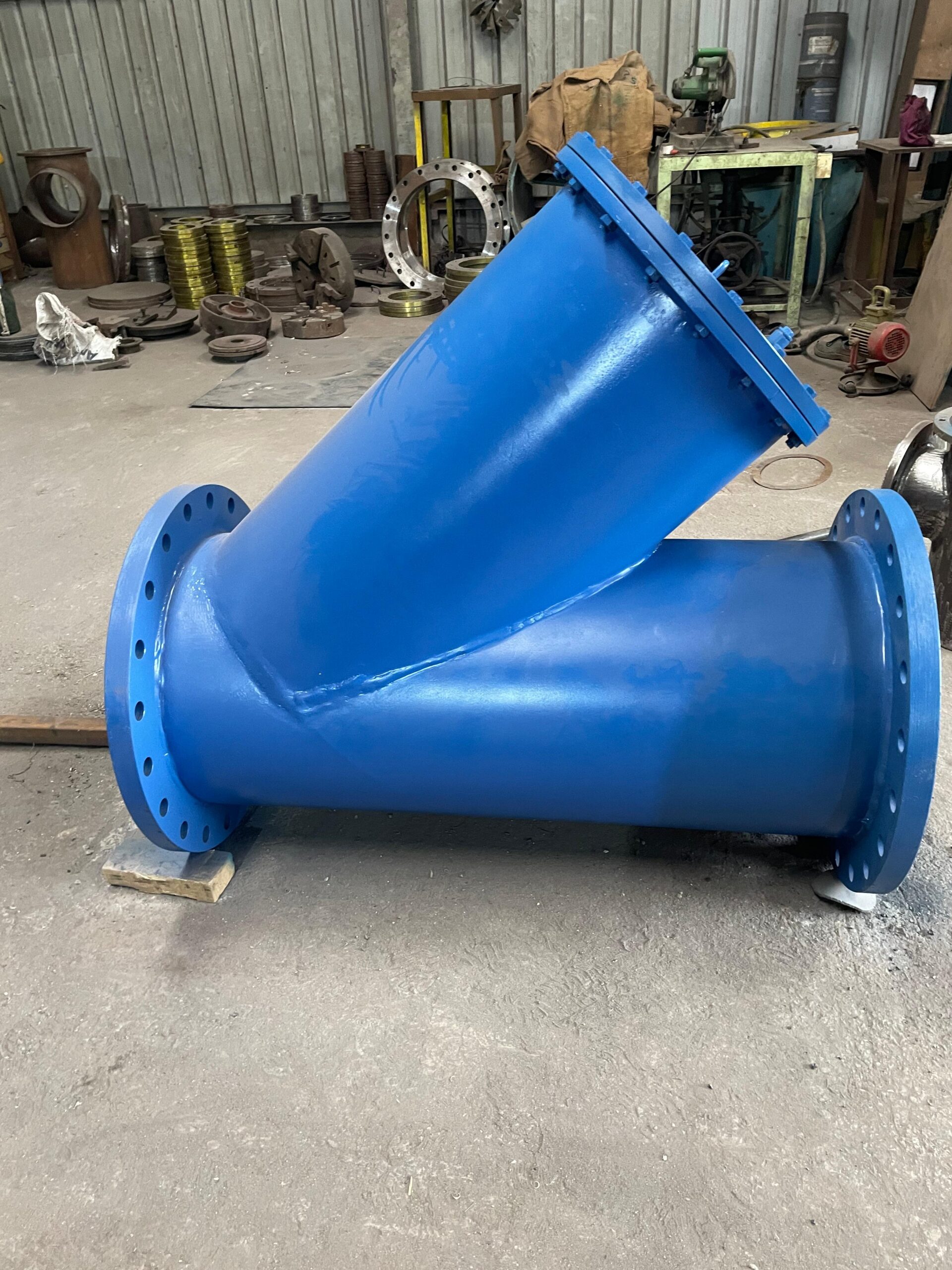
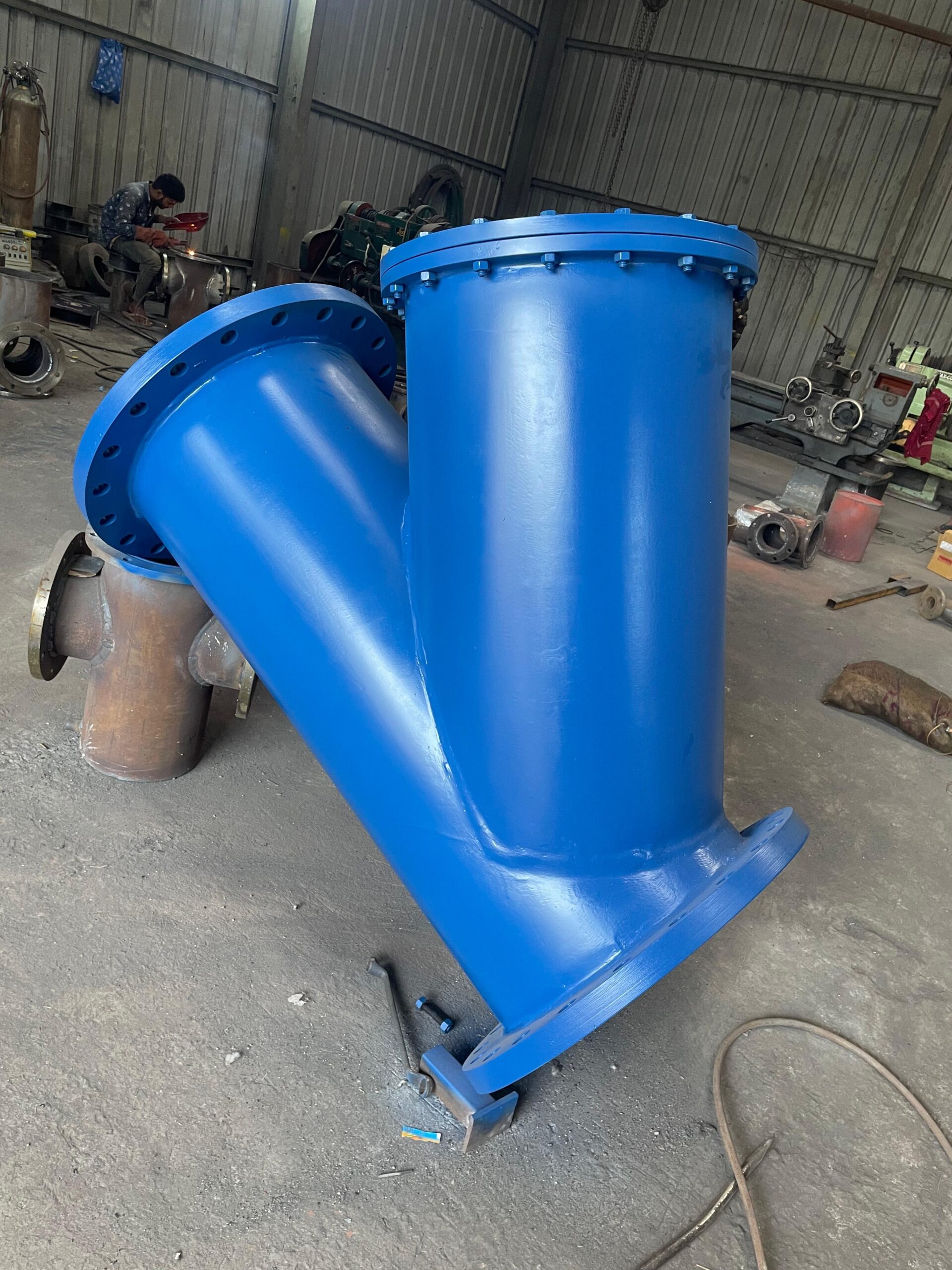
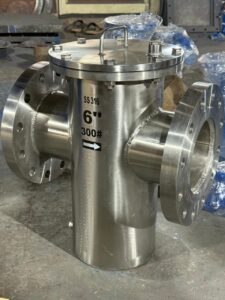
Ease of Maintenance: Equipped with a bolted cover for easy screen removal or an optional blow-off valve for self-cleaning without stopping the flow.
General Specifications
Design & Manufacturing Standard: Generally adheres to in-house standards (e.g., “Lehry 014”) or relevant industry standards like ASME B16.34, IBR.
Inspection & Testing Standard: Typically follows API 598 or EN 12266.
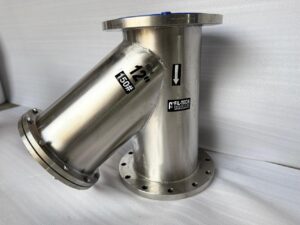
Configuration: Y-shaped body with a removable screen element.
Cover Type: Usually a bolted or quick-release clamp cover with a gasket seal (PTFE, CAF, Neoprene, or Viton, depending on temperature/media compatibility).
Installation: Can be installed horizontally or vertically, provided the screen/basket is oriented in a downward position.
Material of Construction (MOC)
Fabricated strainers are made from pipe and plate materials, offering versatility in selection.
Body:
Carbon Steel/Mild Steel: IS 2062 Gr B, ASTM A53 Gr B, ASTM A106 Gr B/C, ASTM A516 Gr 70.
Stainless Steel: SS304, SS304L, SS316, SS316L (ASTM A240, ASTM A312).
Alloy Steel: ASTM A335 (P11, P22).
Duplex Steel: ASTM/ASME SA 790 (UNS S31803, S32205, S32750).
Screen/Element: Typically Stainless Steel (SS304 or SS316) perforated sheet and/or wire mesh.
Bolts & Nuts: Carbon Steel (IS 1363) or Stainless Steel.
Dimensions & Performance
Size Range: Highly customizable due to fabrication, commonly available from 1/2″ (DN15) to 48″ (DN1200).
End Connections:
Flanged: Most common, available in ANSI B16.5 Class 150#, 300#, 600# (Raised Face standard).
Welded: Butt Weld (BW) or Socket Weld (SW) to standards like ASME B16.25 or B16.11.
Threaded: NPT or BSP for smaller sizes up to 2″.
Pressure Ratings: Varies by class and material, typically ranging from Class 150 to 600#, with options up to Class 1500# or higher for specialized applications.
Filtration Levels: Customizable mesh sizes available from coarse straining (e.g., 2-500 mesh) down to fine filtration (e.g., 5 to 3000 microns).
Pressure Drop: Designed for minimal initial pressure drop, often around 0.05 Kg/cm² (g) when clean.


Reviews
There are no reviews yet.